Magnet Safety & Storage Tips for Miniature Hobbyists
Neodymium magnets are remarkably strong for their size. That's what makes them perfect for miniatures — and also what makes them worth respecting. A few common-sense precautions will keep you, your household, and your magnets in good shape.
Pinch Hazard: The #1 Risk
Even small neodymium magnets snap together with surprising force. Two 6mm x 3mm N52 magnets accelerating toward each other can pinch skin hard enough to break blood vessels and cause blood blisters. Larger magnets (10mm+) can crack fingernails or cut skin.
When handling magnets:
- Slide magnets apart rather than pulling them straight off each other. Sliding takes far less force and gives you more control.
- Keep a stack of magnets on the table, not in your hand, when working. Pull one off the stack at a time.
- Use tweezers or Magnicators for magnets 3mm and smaller. Your fingers are too big to maintain control over magnets this small, and they'll jump onto nearby magnets or tools without warning.
- Work over a contained area. A small tray or box lid keeps dropped magnets from rolling onto the floor where they're nearly impossible to find (and a hazard for bare feet, pets, and vacuums).
Children and Pets: Serious Swallowing Hazard
This is not an exaggeration. If a child or pet swallows two or more neodymium magnets, seek immediate emergency medical attention.
Multiple swallowed magnets can attract each other through the walls of the intestines, pinching tissue between them. This can cause intestinal blockage, perforation, infection, and can be life-threatening. A single swallowed magnet will usually pass naturally, but two or more is a medical emergency.
- Keep all magnets out of reach of children under 14
- Don't leave loose magnets on tables or work surfaces unattended
- Store magnets in sealed containers, not open dishes or bags
- If you have pets that chew or eat small objects, treat magnets with the same caution as hobby knife blades
Electronics and Magnetic Media
Neodymium magnets can damage or interfere with:
- Credit cards and hotel key cards — the magnetic stripe will be wiped. Chip-only cards are unaffected, but many cards still have stripes.
- Mechanical hard drives — strong magnets near a spinning HDD can corrupt data. SSDs are immune.
- Pacemakers and insulin pumps — neodymium magnets can interfere with implanted medical devices. Maintain significant distance.
- CRT monitors and old TVs — rare these days, but magnets will distort the display.
- Mechanical watches — strong magnetic fields can magnetize the hairspring, affecting timekeeping accuracy.
- Compasses and navigation equipment — obviously.
Keep your magnet supply at least 30cm (12 inches) away from wallets, phones, laptops, and any sensitive electronics on your hobby desk.
Storage Best Practices
Proper storage keeps your magnets organized, safe, and at full strength for years.
- Keep magnets in their original packaging whenever possible. The bags or containers they ship in are sized to prevent them from snapping together violently.
- Separate sizes. Mixing 2mm and 6mm magnets in one container means the small ones will cluster around the large ones and become difficult to separate.
- Use small labeled containers or bags. Pill organizers, small zip bags, or compartmented hobby boxes work well. Label each with the magnet size.
- Avoid loose magnets near metal tools. Magnets that attach to hobby knives, clippers, or files are annoying to remove and can cause tools to become slightly magnetized themselves.
- Store in a dry location. Neodymium magnets have a nickel coating for corrosion protection, but prolonged exposure to moisture can still cause surface degradation over time.
Temperature Warnings
Standard N52 neodymium magnets begin to permanently lose magnetic strength above 80°C (176°F). At their Curie temperature (~310°C), they demagnetize completely.
Practical implications:
- Don't leave magnets in a hot car. A sealed car in summer sun can reach 60-80°C inside. The dashboard and areas in direct sun can exceed the 80°C threshold.
- Don't use heat guns near embedded magnets. If you're using a heat gun to reshape plastic parts, be aware that the magnet inside can be affected.
- Soldering near magnets can generate enough localized heat to weaken them. Keep distance or remove the magnet first.
- Normal hobby conditions are fine. Room temperature, gaming stores, convention halls — none of these will affect your magnets.
Handling Small Magnets (3mm and Under)
The magnets most commonly used in miniatures — 2mm x 1mm, 3mm x 2mm — are small enough to present unique handling challenges:
- They jump. Bring a small magnet within 10-15mm of another magnet or steel surface and it will leap across the gap. This happens faster than you can react.
- They're hard to orient. Checking polarity on a 2mm magnet with your fingers is nearly impossible. Use a marked "reference magnet" — a larger magnet with its north face labeled — to test polarity before gluing.
- They disappear. A dropped 2mm magnet will stick to the nearest metal object, roll into a crack, or vanish into carpet. Work over a tray, and keep a spare magnet handy to sweep the area if you lose one.
- Magnicators or reverse-action tweezers give you far better control than fingers for placing tiny magnets into drilled holes.
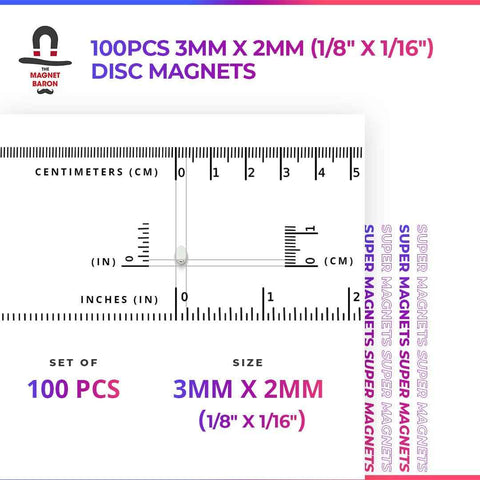 100pcs 3mm x 2mm (Approximately 1/8" x 1/16") Disc Magnets
Regular price
Price
$15.99
 100pcs 2mm x 1mm (Approximately 1/16" x 1/32") Disc Magnets
Regular price
Price
$11.99
First Aid
If magnets pinch your skin and cause a blood blister, treat it like any minor crush injury — ice, keep it clean, and let it heal. If magnets break (they're brittle and can shatter on hard impacts), the fragments are sharp. Sweep them up with a larger magnet wrapped in tape, then discard the tape and fragments together.
For any ingestion incident: call Poison Control (1-800-222-1222 in the US) or go to the emergency room immediately. Do not wait for symptoms.